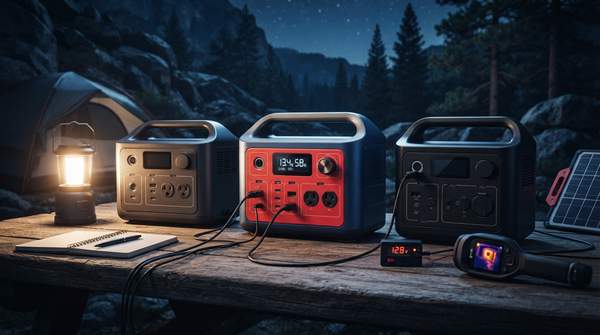
If you want a portable power station for camping, the tested evidence points to three standout options: the Anker Solix C1000 Gen 2, which pairs a 59-minute tested AC recharge with 870 watt-hours of usable energy; the Bluetti Elite 100 V2, the most efficient medium unit CNET's testers measured; and the Jackery Explorer 1000 v2, which packs 1,070 watt-hours into a camping-oriented design. All three use LiFePO4 battery chemistry, which independent reviewers rate for thousands of charge cycles — the single biggest factor in long-term value. We synthesized published test results from CNET's lab testing and expert reviews to show where each model wins and where it gives something up.
Choosing Your Portable Power Station: Key Trade-offs
Capacity alone tells you little. As the reviewers at Power Station Pick put it, two models can share nearly identical capacity "and still perform completely differently once you factor in inverter output, charging speed, battery chemistry, and the specific devices you actually need to run."
Tech Writer EDC's guidance frames the decision by job: a small DC unit keeps a family's devices charged on a road trip, while "a 1,000Wh-class unit like the Jackery Explorer 1000 V2 or Anker C1000 Gen 2 can run a camp refrigerator for much of a day, power a CPAP for multiple nights, or keep essential electronics working during an outage." That 1,000-watt-hour class is the sweet spot for camping and short outages — enough for real appliances without whole-home backup bulk. Here's how to weigh the variables:
- Usable capacity: Raw watt-hours overstate what you can actually draw. CNET measures "active energy" — what a unit delivers in practice — and the efficiency percentage behind it.
- Charge time: Fast recharging matters between camp days or outage extensions; CNET's tests range from under an hour to nearly two.
- Battery chemistry: Cycle-life ratings determine whether the unit still holds most of its capacity years from now.
- Weight: Every pound counts when the station rides in and out of a car at a campsite.
Portable Power Stations Compared: Tested Performance
The table below compares our three models on the dimensions that matter most for outdoor use. Test data comes from CNET's lab measurements and from Tech Writer EDC's real-world picks; the Jackery figures are manufacturer-stated specifications as catalogued by Power Station Pick.
| Model | Usable capacity | AC charge time | Battery chemistry (cycle life) | Weight | Best for |
|---|---|---|---|---|---|
| Anker Solix C1000 Gen 2 | 870.08 Wh tested active energy (85.0% usable capacity) | 59 minutes (CNET tested) | LiFePO4 | Not stated in the evidence reviewed | Weekend camping trips needing dependable, fast-charging power |
| Bluetti Elite 100 V2 | 1,024 Wh (83.44% round-trip efficiency, CNET's most efficient medium unit) | 1 hour, 55 minutes (CNET tested) | LiFePO4, rated more than 4,000 cycles to 80% capacity | 25 lbs | Serious capacity without bulk; 1,800W continuous output covers most camping needs |
| Jackery Explorer 1000 v2 | 1,070 Wh (stated) | 1 hour fast charge (stated) | LiFePO4, 1500W AC / 100W USB-C output (stated) | Not stated in the evidence reviewed | Outdoor enthusiasts and emergency preparedness, per its listing |
The trade-offs are visible immediately. The Anker gives up some raw capacity but recharges in about an hour by CNET's measurement — a real advantage when you're topping up between outings. The Bluetti returns 83.44% of the energy you put in, the best efficiency rating CNET recorded among medium units, and its 25-pound weight keeps weekend portability realistic. The Jackery offers the largest stated capacity of the three for longer trips, though its figures come from catalogued specifications rather than independent test measurements.
To make those watt-hours concrete: at a typical 45-watt draw for a portable camping fridge, the Anker's tested 870.08 watt-hours translate to roughly 19 hours of continuous cooling (870 ÷ 45 ≈ 19). For context, CNET's larger 3,072-watt-hour test unit ran a fridge for 28.97 hours in their lab.
LiFePO4 vs. Lithium-ion (NMC): Understanding Battery Longevity
The most consequential spec on the box is the one casual shoppers skim: chemistry. LiFePO4 (lithium iron phosphate, or LFP) cells differ from older lithium-ion (NMC) formulations in how many charge-discharge cycles they survive before capacity significantly degrades.
Power Station Pick's editors are blunt about the stakes: "LiFePO4 (LFP) models are the gold standard, lasting 10+ years (3,000+ cycles), while Lithium-ion (NMC) models typically last 3-5 years."
CNET's testing team echoes that finding, noting that LiFePO4 adoption across modern stations — including Anker Solix models, Bluetti units, and the Jackery Plus series — brings "a significantly longer lifespan, often rated for 3000 to over 6500 charge cycles before significant capacity degradation," plus improved thermal stability and safety across a wider range of temperatures.
What that means for your wallet: a unit like the Bluetti Elite 100 V2, rated for more than 4,000 cycles before falling to 80% of original capacity, could sustain years of weekly camping trips. An NMC unit lasting 500–800 cycles by comparison would likely need replacement several camping seasons sooner — making a slightly costlier LiFePO4 model the better long-run value if you use it frequently. That comparison rests on typical cycle-life ratings from expert reviews; actual longevity varies with usage patterns and conditions.
Making Your Decision: Balancing Needs and Durability
Match the unit to your actual scenario rather than the biggest number on a listing. For weekend campers who recharge between trips, the Anker Solix C1000 Gen 2's tested 59-minute recharge and 870 usable watt-hours — enough for roughly 19 hours of fridge runtime — reduce downtime to almost nothing. For multi-day trips where every pound carried matters, Tech Writer EDC reports the 25-pound Bluetti Elite 100 V2 "hits a sweet spot between small USB-focused units… and the heavier AC180," with 1,800W continuous output that handles most camping appliances. For longer stays or emergency overlap, the Jackery Explorer 1000 v2's 1,070-watt-hour stated capacity gives extra headroom, though you'd be relying on manufacturer figures rather than lab-verified results.
One honest caveat on scope: this comparison reflects independently tested data where it exists, not a hands-on test of every feature. It omits solar charging performance and detailed port configurations, since those aren't consistently documented across the evidence reviewed, and it's aimed at camping-scale units rather than whole-home backup.
Your Best Portable Power Station Decision
Choose a portable power station with LiFePO4 battery chemistry for long-term durability, then weigh the trade-off between tested usable capacity, charging speed, and portability against your primary outdoor use case — fast recharge for the Anker, efficiency and light weight for the Bluetti, stated capacity for the Jackery.
The measurable indicator that you chose well: the station consistently meets your power demands across planned camping trips — fridge hours, CPAP nights, device recharges — and maintains at least 80% of its original capacity after several years of use, the degradation threshold LiFePO4 ratings are built around.