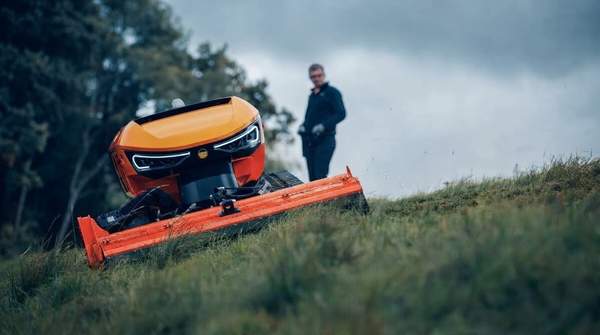
Choosing a robotic lawn mower for a large yard with challenging terrain, such as steep slopes or uneven ground, requires careful consideration of specific performance metrics and advanced features. Homeowners need to evaluate a mower's maximum slope handling, drive system, navigation technology, and how its battery and cutting width contribute to overall coverage and efficiency. This guide compares leading models to help you match a mower's capabilities to your property's unique demands.
Slope Handling and Drive Systems: Conquering Steep Terrain
For yards with significant inclines, a robotic lawn mower's ability to handle steep slopes is paramount. This capability is often expressed in both degrees and percentages, with higher numbers indicating greater climbing power. Beyond the raw slope rating, the drive system plays a critical role in maintaining traction and stability on uneven or hilly terrain.
Specialized drive systems, such as All-Wheel Drive (AWD) and tracked treads, offer superior performance compared to standard wheeled systems. For instance, the Mammotion LUBA 3 AWD series features an advanced All-Wheel Drive system with dedicated power units for each of its four wheels, providing exceptional ground grip and precise control. This design allows the LUBA 3 to climb slopes up to 80%, which translates to approximately 38.6 degrees, according to MAMMOTION Europe. Similarly, PCMag reports that the Mova Lidax Ultra 3000 AWD also delivers outstanding slope-handling, capable of managing inclines up to 80% (40 degrees) thanks to its AWD system.
Another robust option for challenging terrain is a tracked drive system. The Lymow One Plus, for example, utilizes tracked treads for propulsion, enabling it to handle slopes up to 45 degrees (100%). Lymow Tech highlights that this model is designed to cross obstacles up to 2.8 inches, further enhancing its adaptability to uneven ground.
When evaluating a mower's slope handling, it's important to ensure its capabilities meet or exceed the steepest incline in your yard. CNET emphasizes that some mowers are better at navigating difficult terrain than others, with varying degrees of slope they can manage.Navigation Technologies: Mapping Large and Complex Yards
Modern robotic lawn mowers employ sophisticated navigation technologies to efficiently cover large areas and maneuver through complex yard layouts without the need for physical perimeter wires. These wire-free systems offer greater flexibility and easier setup.
Key navigation technologies include:
* RTK (Real-Time Kinetic): This is a type of GPS satellite positioning that is enhanced by local antennas or cellular connections for improved accuracy. Wirecutter explains that RTK systems provide precise positioning, making them suitable for large and intricate yards. The BESTMOW Robot Lawn Mower, for instance, uses RTK combined with "4 Eye Vision" for mapping and anti-theft technology. Roborock's RockMow X115H also features full-band RTK, as noted by PCMag.
* LiDAR (Light Detection and Ranging): LiDAR sensors use light pulses to create a detailed 3D map of the environment, enabling excellent obstacle avoidance and stable operation in complex yards. PCMag reports that the Mova Lidax Ultra 3000 AWD utilizes 3D LiDAR, making it well-suited for lawns with hills or awkward contours. SUNTEK also notes that robot mowers equipped with LiDAR excel at obstacle avoidance and run more stably in complex yards. The Ecovacs Goat A2000 LiDAR Pro is another model that incorporates LiDAR technology.
* VSLAM (Visual Simultaneous Localization and Mapping): Camera-based VSLAM systems use built-in cameras for navigation and obstacle detection. Wirecutter describes VSLAM as being "like facial recognition for your lawn," allowing the mower to distinguish between grass, pavement, and other objects. The Lymow One Plus combines RTK with VSLAM navigation, which Lymow Tech states is trained on thousands of objects for enhanced terrain features. While vision systems are effective, SUNTEK points out that their main downside can be reduced performance under low-light conditions.
* AI-Assisted Mapping and GPS Tracking: Many advanced mowers integrate AI for smarter mapping and route optimization. The Navimow i105N, for example, features AI-assisted mapping, according to PCMag. Models like the Greenworks Pro Optimow 50H offer cellular connectivity and GPS tracking, which can aid in navigation and provide anti-theft capabilities, as reported by PCMag.
These wire-free navigation systems are crucial for efficiently managing large properties, as they allow the mower to learn and adapt to the yard's layout, ensuring comprehensive coverage and effective obstacle avoidance.Coverage Area, Battery Life, and Cutting Efficiency
The maximum coverage area a robotic lawn mower can handle is a primary consideration for homeowners with large yards. This capacity is directly influenced by the mower's battery life and, to some extent, its cutting deck width.
Wirecutter explains that how much acreage a robot mower can handle is determined by its battery life, with some models capable of covering up to 2.5 acres depending on their battery power. While battery runtime is a factor, SUNTEK suggests that it is often overemphasized because most modern robot lawn mowers support automatic charging. The more critical factor is ensuring the mower's rated working coverage matches or exceeds the total size of your lawn, as many models also have software limits on mapped areas.
The cutting width, which refers to the area a mower cuts in a single pass, also impacts efficiency. CNET notes that a slimmer cutting radius might require the mower to make more passes to cover the same area. For larger lawns, a wider cutting deck can reduce the overall time needed to complete the mowing task, even if it means fewer passes.
For example, the Lymow One Plus is rated for a coverage area of up to 1.73 acres per day, demonstrating how battery capacity and efficient design contribute to its ability to manage substantial lawns. When selecting a mower, prioritize models with sufficient coverage ratings for your specific lawn size, as their battery capacity will generally be designed to meet those needs.
Matching a Mower to Your Yard's Specific Needs
To make an informed decision, synthesize the information on slope handling, navigation, and coverage to find the robotic lawn mower best suited for your specific yard conditions.
Consider the following:
* Steep Slopes: If your yard features significant inclines, prioritize models with high maximum slope ratings (e.g., 80% or 40-45 degrees) and robust drive systems like AWD or tracked treads. The Mova Lidax Ultra 3000 AWD and Mammotion LUBA 3 AWD Series are strong contenders for their AWD capabilities and high slope ratings, while the Lymow One Plus stands out with its tracked treads and 45-degree slope handling.
* Large and Complex Layouts: For extensive properties with intricate designs, advanced wire-free navigation systems are essential. Models utilizing RTK, LiDAR, or VSLAM will offer superior mapping, obstacle avoidance, and efficient coverage. The Mova Lidax Ultra 3000 AWD with its 3D LiDAR, or models combining RTK and VSLAM like the Lymow One Plus, are well-equipped for such environments.
* Overall Efficiency: Ensure the mower's stated maximum coverage area aligns with your lawn size. While battery life is important, focus on the total acreage capacity, as most modern mowers manage their charging cycles automatically. A wider cutting deck can also contribute to faster completion times for larger areas.
By carefully evaluating these performance metrics and features, homeowners can select a robotic lawn mower that not only handles the challenges of large yards and steep terrain but also provides efficient, wire-free operation.